


Miraikan Trial Tests Mixed-Reality Door Connecting Two Worlds
The National Museum of Emerging Science and Innovation, known as Miraikan, is hosting an event that offers visitors a mixed-reality experience centred on the World Link Door system. The experiment asks participants to pass through a doorway connecting a physical setting to a virtual one, creating a staged journey between the two environments.
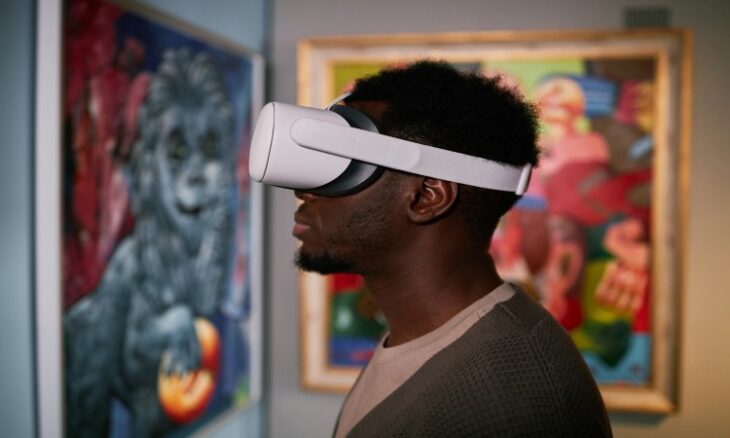
Participants first put on a head-mounted display before taking part in the task. They are then instructed to move through the real and virtual door, continue along a narrow path set in outer space, collect a designated item, and return safely. The setup is designed to combine physical movement with virtual scenery, rather than relying on visuals alone.
The system is being developed by the Nara Institute of Science and Technology (NAIST) and NTT Docomo. The current proof-of-concept experiment began on July 8 and is intended to help refine the technology so that movement between real and virtual spaces becomes smoother. NAIST’s Cybernetics and Reality Engineering Laboratory has been studying this area of research for about five years. It has worked with NTT Docomo’s R&D Innovation Division on the system since 2024.
The project also drew large crowds at demonstration events during the Osaka Kansai Expo last year. The research is focused on one of the main problems in virtual reality. When only the visual environment changes and the user remains physically still, the experience can feel inconsistent and less convincing. The World Link Door is intended to reduce that disconnect by adding the act of walking through a door, providing the user with a physical transition that corresponds to the change in the virtual scene.
The version now being shown at Miraikan has been updated since the Osaka Expo demonstrations. The changes include simpler user actions and improved sound design. These adjustments are intended to make the experience more straightforward for participants while sustaining the core mixed-reality format. The current run is also part of a broader effort to collect input from trial participants and use it to improve the system.
The current run of the experiment is scheduled to end on Aug. 18 and is due to return from April to September next year. Each session lasts between 20 and 30 minutes. Same-day numbered tickets are issued at the venue. Participation is free, although visitors need a separate paid ticket if they want to view Miraikan’s exhibitions. The developers plan to gather data from 1,000 participants as they continue improving the system, with practical use targeted within five years. The developers plan to use that data to make further improvements before the project returns for another run next year.
The trial is being used to assess how visitors respond to the experience in practice. The current demonstration remains limited in duration and scale, but it is intended to support further refinement of the technology. The work at NAIST and NTT Docomo remains centred on improving the transition between the physical and virtual parts of the experience, whilst maintaining the sense of movement that the system is built to provide.